

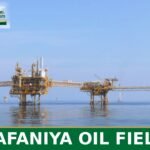





Safaniya is the largest offshore oil field in the world. It lies under the shallow waters of the Arabian Gulf, about 260 kilometres north of Dhahran, and it has been producing oil since 1957.
This guide explains how Safaniya was found, how it works, and why it is still one of Saudi Arabia’s most important fields after more than 70 years.
| Quick Facts — Safaniya Oil Field | |
|---|---|
| Location | Arabian Gulf, about 260 km north of Dhahran, Eastern Province |
| Discovered | 1951 — first offshore well Safaniyah No. 1 completed 15 August 1951 |
| Production started | Mid-April 1957 — about 50,000 barrels a day from 18 wells |
| Size | About 50 km long and 15 km wide; roughly 750 sq km |
| Rank | World’s largest offshore oil field |
| Crude type | Heavy crude — Arabian Heavy, 27 degrees API |
| Production capacity | Around 1.3 million barrels a day |
| Recoverable reserves | Around 34–36 billion barrels of oil equivalent (estimates vary) |
| Operator | Saudi Aramco |
The Red Arrow on the Map
Safaniya began with a guess drawn on a map. In 1939, Aramco geophysicist Dick Kerr was studying the shallow waters off Saudi Arabia’s northern Gulf coast. He marked a spot with a red arrow and wrote: “Possible high area offshore.”
Kerr’s idea came from aerial surveys and seismic work. The Gulf there is shallow, and the rock structure under the water looked like it could hold oil. But in the 1930s, nobody had drilled offshore in the Gulf, and the equipment to do it barely existed.
By the late 1940s, Aramco was firmly established onshore in the Eastern Province. The company had found Dammam, Abqaiq and Ghawar on land. The next step was to look under the sea.
Safaniya was chosen as the first offshore drilling site. The plan was simple to state and hard to do: build a rig that could drill in open water, using the equipment and logistics available at the time.
The First Offshore Well, 1951
The first offshore wildcat well, Safaniyah No. 1, took more than 200 days to drill. It was completed on 15 August 1951, and it confirmed what Kerr had suspected: hydrocarbons lay beneath the Gulf floor.
The well did more than find oil. It proved that offshore drilling could be done safely and effectively in the Gulf’s shallow waters. That proof opened the whole offshore Arabian Gulf to exploration.
Between 1951 and 1954, Aramco drilled 17 appraisal wells to map the field. In 1954, the company finalised plans to build the facilities needed to bring Safaniya into production, aiming for a 1957 start.
The field entered production on schedule in mid-April 1957. It flowed about 50,000 barrels a day from just 18 wells. By 1962, the field already had facilities to handle 350,000 barrels a day from only 25 wells.

How Big Is Safaniya?
Safaniya measures about 50 kilometres long and 15 kilometres wide, covering roughly 750 square kilometres of seabed. An older technical paper put its length at about 39 miles along its north-east to south-west axis.
That makes it the largest offshore oil field in the world, by both reserves and production capacity. Its capacity today is around 1.3 million barrels a day — more than many whole countries produce.
The field’s growth was fast. In 1965 alone, its capacity rose by 150,000 barrels a day to more than 600,000 barrels a day. At the time, that was the highest output from a single field in the company’s history.
Reserves are harder to pin down. Published estimates put recoverable oil at around 34 to 36 billion barrels of oil equivalent, with total oil in place above 50 billion barrels. The range reflects different counting methods, not disagreement about the field’s size.
Heavy Crude and Four GOSPs
Safaniya’s crude is heavy. It rates 27 degrees on the API gravity scale, which means it is thick and rich in fuel oil. When the discovery well was first tested, Aramco’s refining men were disappointed by the grade — but the sheer volume of oil more than made up for it.
Heavy crude needs more processing than light crude, and it sells at a discount. Refineries built to handle it, mostly in Asia, are Safaniya’s main customers. The field’s output is sold as Arabian Heavy.
Today the field runs on four offshore gas oil separation plants — GOSP-1, GOSP-2, GOSP-3 and GOSP-4 — plus a major onshore central processing facility. More than 750 kilometres of subsea pipelines connect the platforms, and the field has over 600 wells.
The platforms themselves are small industrial towns at sea. Workers reach them by boat and helicopter, and they live and work offshore in shifts. It is a very different life from the desert camps of the onshore fields.
Keeping an Old Field Young
Safaniya is more than 70 years old, and Aramco works hard to keep it producing. The company runs a Master Development Plan for the field, upgrading platforms, drilling new wells and using enhanced recovery methods to sustain its capacity of about 1.3 million barrels a day.
Offshore fields age differently from onshore ones. Salt water corrodes steel, storms damage structures, and every repair needs a boat or a helicopter. The 2019 incident showed the risk: in February 2019, the field was partly shut down after a ship’s anchor cut a main power cable.
The field also taught Aramco how to work offshore. The experience gained at Safaniya led to the discovery of the Abu Sa’fah offshore field in 1963, and to the whole offshore industry of the Gulf. Aramco calls Safaniya its “first step offshore” for good reason.
Its onshore twin is just as famous. Ghawar, discovered in 1948, is the world’s largest onshore oil field. Together, the two fields are the foundation of Saudi production, and our pillar guide to oil and gas in Saudi Arabia puts them in the national picture.

Safaniya and the Companies Behind It
Safaniya is owned and operated entirely by Saudi Aramco. But a field this size needs an army of contractors. The big international service firms — SLB, Halliburton, Baker Hughes and Weatherford — all work in the Kingdom, and offshore work is a large part of what they do.
Their jobs include drilling, well completion, seismic surveys and maintenance of the platforms and pipelines. Much of this work is done from specialised ships, and it employs thousands of people in the Eastern Province.
For readers interested in the employers, our guide to oil and gas companies in Saudi Arabia covers Aramco, SABIC and the service firms. Our guide to Aramco jobs explains how to apply for work with the company itself.
Visitors should know the field is not open to the public. The platforms sit far offshore and are closed industrial sites. The closest most people get is the coast around Jubail and the Eastern Province, which our guide to places to visit in Dammam and Khobar covers.
Frequently Asked Questions
Where is the Safaniya oil field?
Safaniya is in the Arabian Gulf, about 260 kilometres north of Dhahran in Saudi Arabia’s Eastern Province. It is the world’s largest offshore oil field, and it is operated by Saudi Aramco.
When was Safaniya discovered?
Safaniya was discovered in 1951. The first offshore well, Safaniyah No. 1, was completed on 15 August 1951 after more than 200 days of drilling. Production began in mid-April 1957.
How much oil does Safaniya produce?
Safaniya’s production capacity is around 1.3 million barrels a day. It started at about 50,000 barrels a day in 1957 and reached 600,000 barrels a day by 1965.
What kind of oil does Safaniya produce?
Safaniya produces heavy crude oil, sold as Arabian Heavy. It rates 27 degrees on the API gravity scale, which means it is thick and rich in fuel oil, and needs more refining than light crude.
Can you visit the Safaniya oil field?
No. Safaniya’s platforms are offshore industrial sites, closed to the public and reached only by boat or helicopter. The coastal cities of the Eastern Province, such as Jubail and Khobar, are the nearest places to visit.