










Jeddah is the Red Sea gateway of Saudi Arabia. It is the port that has welcomed travellers for centuries, and it is the most cosmopolitan city in the Kingdom.
This guide covers the ten best places to visit in Jeddah, from the UNESCO streets of Al-Balad to the 30-kilometre Corniche. It also covers the best time to go and how to get around the city.
| Quick Facts — Places to Visit in Jeddah | |
|---|---|
| Best time to visit | November to March — mildest weather (winter 19–31 °C) |
| Summer temperatures | 25–41 °C — hot and humid; evenings are the time to be out |
| UNESCO site | Historic Jeddah (Al-Balad) — inscribed 2014, “the Gate to Makkah” |
| Corniche | 30 km of Red Sea waterfront; open 24 hours, liveliest from 4 PM |
| King Fahd’s Fountain | 312 m high — the tallest fountain in the world; free to watch |
| Getting around | Walk in Al-Balad; taxi or Uber to the Corniche; no metro yet |
| How long | Two days covers Al-Balad, the Corniche and the museums |
Historic Jeddah — Al-Balad
Al-Balad is Jeddah’s historic district, founded in the early 7th century. It was the commercial centre of the city and the primary gateway to Makkah, and UNESCO inscribed it in 2014 as “Historic Jeddah, the Gate to Makkah”.
The district is free to explore. Walk the winding alleys between coral-stone houses with their intricate latticed wooden windows and balconies, the rawasheen. Weekend hours run Friday 10 AM to midnight and Saturday 9 AM to midnight, and the area is best in the cooler morning and evening hours.
The souqs are still alive. Souq Al-Alawi is the oldest and largest, selling spices, incense and herbs. Souq Al-Jamei sells fabrics and accessories, and Souq Qabil is the gold souq. Stop at Diyab Coffee, the oldest café in Al-Balad, for almond coffee.
Beit Nassif and the Heritage Houses
Beit Nassif is a 155-year-old mansion in Historic Jeddah. It was once a residence for King Abdulaziz, the founder of modern Saudi Arabia, and it holds grand rooms and historical artefacts. A neem tree older than 130 years guards its entrance.
Its hours and ticket price were not verified from the official source, so check before you go. The same applies to the other heritage houses of Al-Balad — Bait Ba’eshen, Bait Al-Sharbatly and Bait Al-Mutbuli — which are best seen from the outside as you walk the district.
The Red Sea Museum sits inside the Bab Al-Bunt Building in Historic Jeddah. It explores Red Sea stories — ancient trade routes, seafaring, coral reefs and coastal communities — through interactive exhibits and historical collections. Its hours and ticket price were also not verified, so check at the museum.
Jeddah Corniche
The Jeddah Corniche is a 30-kilometre Red Sea waterfront promenade, and it is where the city spends its evenings. It has sculptures, cafés and leisure spots, and public installations from the Jeddah Open-Air Museum along the way.
The North Corniche covers about 236,000 square metres, from the Border Guard Center to Nawras Roundabout, with gardens, playgrounds and kiosks. The Central Corniche runs about 3.6 kilometres and is home to King Fahd’s Fountain. The Corniche is open 24 hours and is most lively from 4 PM onwards.
Come at sunset. The light on the Red Sea is the reason the Corniche fills up every evening, and the walk from the north to the centre takes you past the best of the waterfront.
King Fahd’s Fountain
King Fahd’s Fountain is the tallest fountain in the world, at 312 metres high. Its waters decorate Jeddah’s sunset and are visible across the city. It was gifted to Jeddah by King Fahd in 1985.
The base is shaped like a mabkhara, an incense burner, as a sign of hospitality and welcome. There are no tickets to see it — the best view is from the Corniche, and VisitSaudi advises a taxi or Uber drop-off across from the Ritz-Carlton, then crossing to the waterfront.
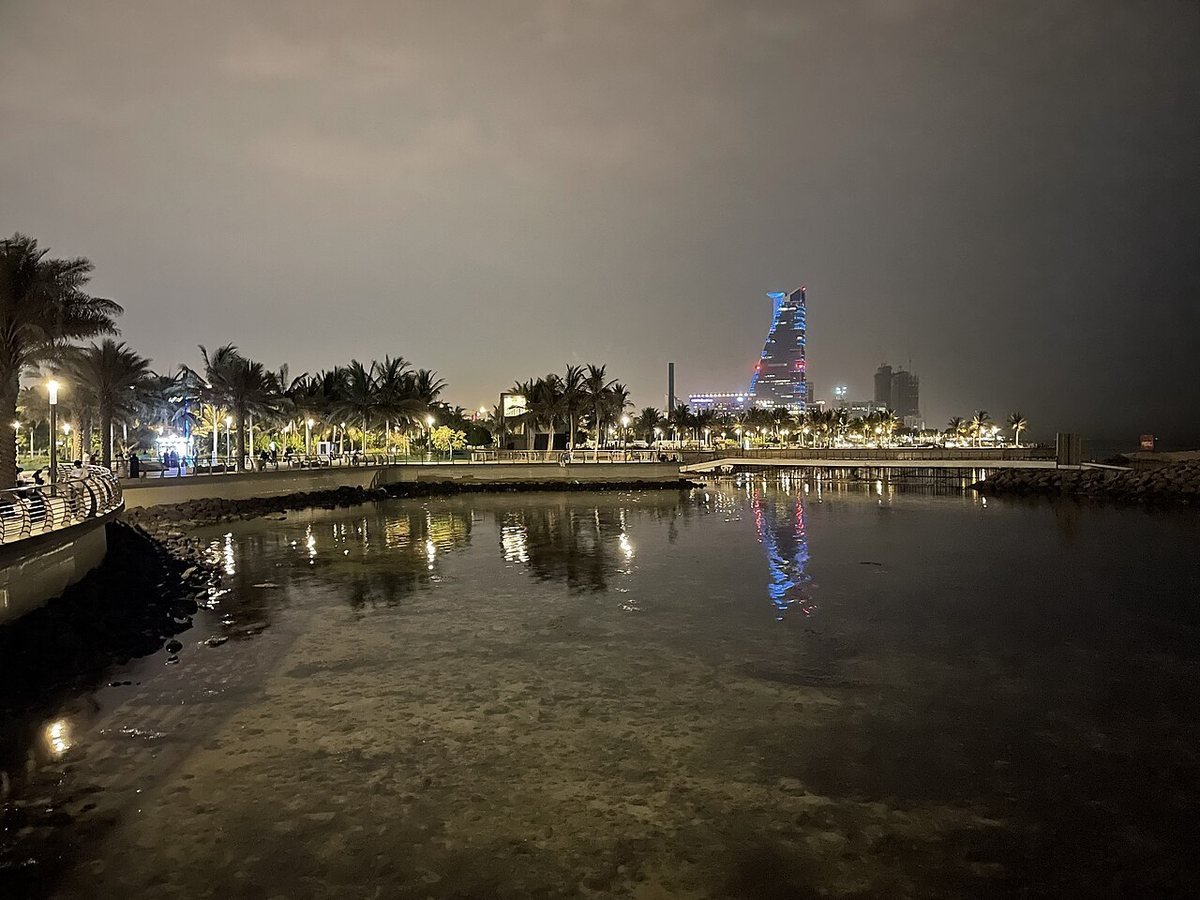
See it after dark, when it is lit. By day it is a landmark on the skyline; at night it is the centrepiece of the Corniche. The photo above was taken on the Corniche after dark, with the waterfront towers lit across the water.
Jeddah Waterfront and the Beaches
The Jeddah Waterfront, also called Roshn Front, is a recently developed 4.2-kilometre stretch of recreational space by the sea. It is more curated than the wider Corniche, with family walks, bike rides, picnics, scooter rides, cafés and kids’ play areas.
It is open from 10 AM to midnight, according to the VisitSaudi weekend guide. Fast-food joints, grocery stores, ice-cream parlours, corn stands and bakeries line the Waterfront, so it works as an easy evening out with children.
The beaches are the other side of Jeddah’s coast. The Corniche area has swimming spots, and the North Corniche sits near Al Shallal Theme Park and the Fakieh Aquarium. Jeddah’s beaches are best in the cooler months, when the humidity drops.

teamLab Borderless Jeddah
teamLab Borderless Jeddah is an immersive digital-art museum in the Historic District, near Culture Square in Al-Balad. Its interactive light displays and digital waterfalls respond to visitor movement, and the art changes as you walk through it.
VisitSaudi’s weekend guide lists Saturday hours of 10 AM to 11 PM, with tickets at SAR 149 for adults and SAR 75 for children. Prices may change, so re-check at booking. It is listed as a family-friendly digital-art universe for all ages.
Pair it with Al-Balad. The museum sits in the historic quarter, so you can walk the old streets first and end inside the light installations. It is one of the few indoor sights in Jeddah that works at any hour.
Fakieh Aquarium and Tayebat Museum
The Fakieh Aquarium sits on the Corniche, near the North Corniche and Al Shallal Theme Park. It is home to more than 200 species from the Red Sea and beyond, with interactive exhibits and sea shows. Its hours and ticket price were not verified from the official source.
The Tayebat Museum, or Al Tayebat International City, is a large museum complex with historical and cultural exhibits on Saudi Arabia’s past — from Islamic heritage to Jeddah’s trading history. A VisitSaudi guided tour pairs an external visit to the museum with Al-Balad and the Corniche.
Both are family stops rather than full-day visits. If you have children, the aquarium and the Waterfront make a good afternoon; if you want history, the Tayebat Museum and the heritage houses of Al-Balad are the better pair.
Tariq Abdul Hakim Museum and Al-Rahma Mosque
The Tariq Abdul Hakim Museum sits in Beit Al-Manoufi in Historic Jeddah. It is dedicated to the Saudi composer who created the national anthem, and it holds his instruments, recordings and personal memorabilia. Weekend hours are Saturday 4 PM to 10 PM, according to the VisitSaudi weekend guide.
The Al-Rahma Mosque, often called the Floating Mosque, is a white mosque on the North Corniche, built over the Red Sea. At high tide it appears to float on the water, and it is popular at sunset. Its visitor details were not verified from an official source, so treat it as a photo stop from the Corniche.
Between the two, you get the two sides of old Jeddah: the music and the sea. Both sit within a short walk of the Al-Balad streets, so they fit into the same morning or evening.
Best Time to Visit Jeddah
November to March is the best time to visit Jeddah. VisitSaudi’s seasonal figures put winter at 19 to 31 degrees — the mildest of the year. Spring runs 23 to 39 degrees, summer 25 to 41, and autumn 23 to 37.
Summer in Jeddah is hot and humid, and the city lives after dark. The Corniche and the Waterfront are most lively from 4 PM, and Al-Balad is best explored in the cooler morning and evening hours. Plan the same way in any season: museums by day, the coast by evening.
Two days is enough for the city. Day one: Al-Balad in the morning, teamLab and the museums in the afternoon, the Corniche at sunset. Day two: the Waterfront, the aquarium and the beaches, with the fountain after dark.
| Jeddah at a Glance | |
|---|---|
| History first | Al-Balad, Beit Nassif, Red Sea Museum — free to explore the district itself |
| The coast | Corniche (30 km, 24 hours), King Fahd’s Fountain (312 m), Waterfront (4.2 km) |
| Families | teamLab Borderless (SAR 149 adults, SAR 75 children), Fakieh Aquarium, Waterfront play areas |
| Shopping | Souq Al-Alawi (spices), Souq Qabil (gold), Souq Al-Jamei (fabrics) |
| Onward travel | Haramain train to Makkah and Madinah; airport taxis to Makkah — see our transport guides |
Getting Around Jeddah
Al-Balad is a walking district. Its alleys are narrow, its souqs are on foot, and a half-day guided tour — the VisitSaudi one includes transport and entry fees, with pickup from your hotel — covers Beit Nassif, Souq Al Alawi and the Al-Shafi’i Mosque in about two hours.
For the Corniche, take a taxi or Uber. VisitSaudi advises a drop-off across from the Ritz-Carlton for the fountain viewpoint, then crossing to the waterfront. The Corniche itself is a walk or a bike ride along 30 kilometres of seafront.
Jeddah is also the gateway to Makkah. Our guides to Haramain train booking and Jeddah airport to Makkah taxi fares cover the journey from the city. For the rest of the country, see our places to visit in Riyadh, places to visit in Dammam and Khobar, places to visit in Abha, places to visit in Taif, places to visit in Tabuk and places to visit in Saudi Arabia guides.
Frequently Asked Questions
Is Al-Balad free to visit?
Yes, the district is free to explore. Weekend hours are Friday 10 AM to midnight and Saturday 9 AM to midnight. The souqs, the heritage houses and the cafés are all inside the old streets.
How tall is King Fahd’s Fountain, and when is it best seen?
It is 312 metres high, the tallest fountain in the world. It is best at sunset and after dark, when it is lit. There is no ticket — watch it from the Corniche, across from the Ritz-Carlton.
How much is teamLab Borderless Jeddah?
VisitSaudi’s weekend guide lists SAR 149 for adults and SAR 75 for children, with Saturday hours of 10 AM to 11 PM. Prices may change, so re-check at booking before you go.
Is the Jeddah Corniche open all day?
Yes, the Corniche is open 24 hours. It is most lively from 4 PM onwards, when the heat eases and the city comes out to walk, eat and watch the sunset over the Red Sea.
Where is the Red Sea Museum?
It is inside the Bab Al-Bunt Building in Historic Jeddah (Al-Balad), a UNESCO World Heritage Site. It explores Red Sea trade routes, seafaring, coral reefs and coastal communities through interactive exhibits.


