










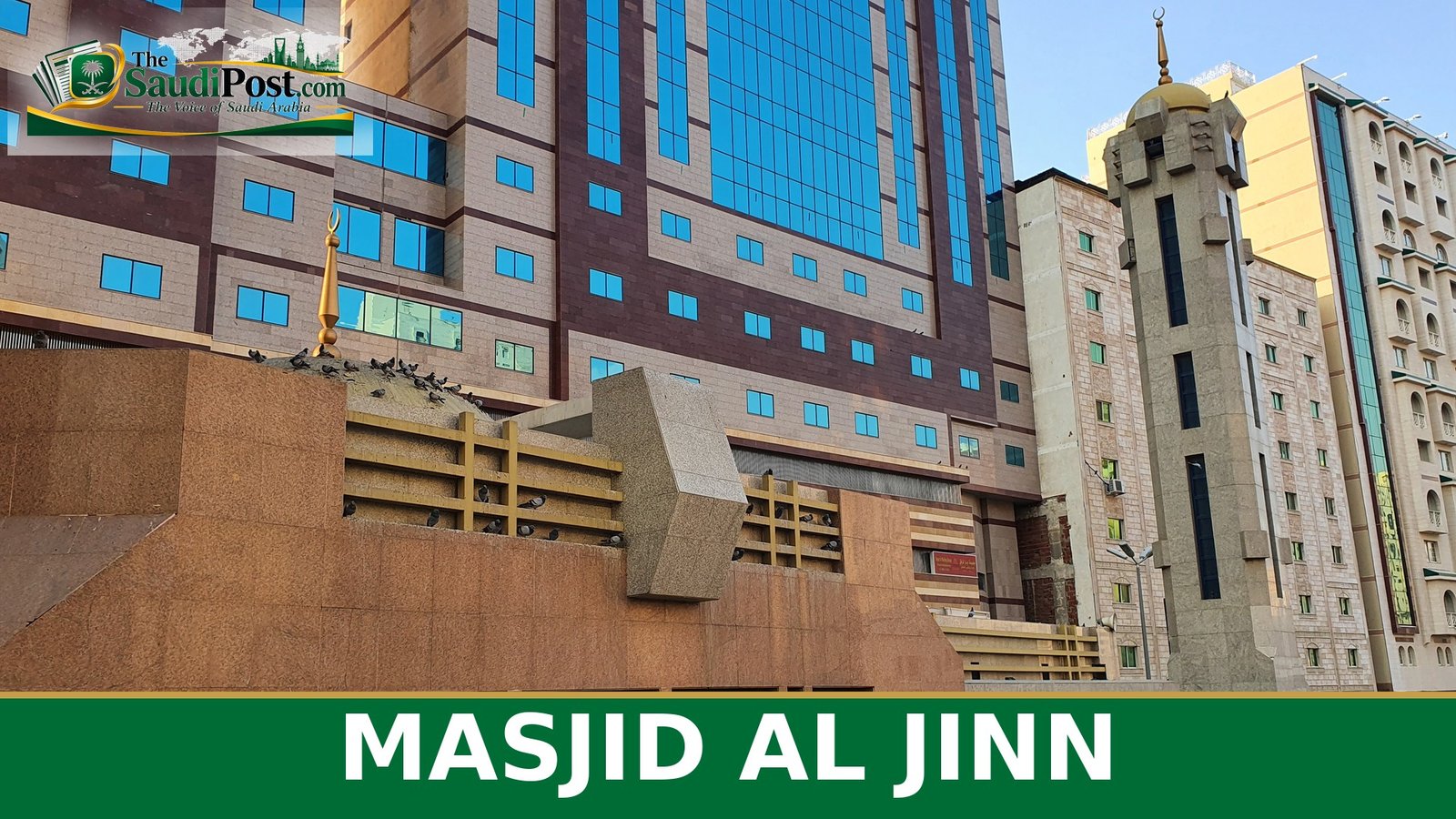
Among Makkah’s mosques, one name always makes visitors pause: Masjid al Jinn — the Mosque of the Jinn.
Standing quietly in the Al-Hajun area near Jannat al Mualla, it marks the site associated with one of the most remarkable nights in the Seerah: the night a delegation of the jinn came to the Prophet Muhammad ﷺ, listened to the Quran, and believed.
The Quran itself tells their story — “Say: It has been revealed to me that a group of the jinn listened and said: Indeed, we have heard a wondrous Quran” (Quran 72:1).
| Quick Facts — Masjid al Jinn | |
|---|---|
| Location | Al-Hajun area of Makkah, near Jannat al Mualla, about 1.5 km north of Masjid al-Haram |
| Also known as | Masjid al-Haras (Mosque of the Guard) |
| Famous for | The site where the Prophet ﷺ recited the Quran to a delegation of the jinn |
| Quran connection | Surah Al-Jinn (72:1) and Surah Al-Ahqaf (46:29) — the jinn listening to the Quran |
| The building today | A modern neighbourhood mosque, rebuilt several times over the centuries |
| Entry | A working mosque — visitors are welcome at prayer times; standard mosque etiquette applies |
The Story Behind the Mosque
The Quran speaks of the jinn hearing the revelation in two places. In Surah Al-Ahqaf, Allah says: “And when We directed to you a group of the jinn, listening to the Quran — and when they attended it, they said: Listen quietly!
And when it was concluded, they went back to their people as warners” (46:29). Surah Al-Jinn opens with the jinn’s own verdict: they had heard “a wondrous Quran” that “guides to rightness, and we have believed in it” (72:1–2).
The books of Seerah connect these verses with encounters in and around Makkah.
Abdullah ibn Masud (RA) narrated — in a report in Sahih Muslim — that he was with the Prophet ﷺ on the night he went out to meet the jinn: the Prophet ﷺ drew a line on the ground for Ibn Masud, told him not to cross it, and went forward to recite the Quran to the jinn delegation.
The mosque in Al-Hajun, near the cemetery, is the site Makkah has long associated with that meeting — hence its names: Masjid al Jinn, and Masjid al-Haras, “the Mosque of the Guard”, from the watch kept that night and the guards of the area in later centuries.

Two Encounters in the Sources
Readers who study the tafsir will notice the scholars distinguishing two related events.
The first is the listening: as the Prophet ﷺ returned from Taif in the tenth year of his mission and prayed Fajr at Nakhlah, a group of jinn passed by, heard the recitation, and believed — the occasion most directly tied to the revelation of Surah Al-Jinn.
The second is the meeting in Makkah itself, when the Prophet ﷺ went out by night — with Ibn Masud (RA) waiting at the line he had drawn — and recited to the jinn delegation and taught them.
Masjid al Jinn in Al-Hajun is the site Makkah’s historians attach to this second encounter. Both events rest on the same Quranic truth the mosque exists to recall: the message of the Quran reached beyond mankind, to listeners unseen.

The Mosque Through the Centuries
A mosque has stood on this site for centuries; historical accounts describe an early structure here that at one period lay partly buried, and the building was renewed repeatedly — an Ottoman-era mosque stood here by around the 18th century, and the mosque visitors see today is a clean, modern building of recent decades, serving the surrounding neighbourhood for the five daily prayers.
Nothing about it is grand — and that is rather the point. Masjid al Jinn is not a monument but a living mosque attached to a Quranic memory.
How to Visit Masjid al Jinn
The mosque is an easy walk from the northern side of Masjid al-Haram (about 20 minutes) or a short taxi ride, and it pairs naturally with Jannat al Mualla, a few minutes away — most ziyarat taxi rounds cover both in one stop.
Visit at a prayer time if you wish to pray inside; dress and behave as in any mosque. There is no prescribed ritual connected to the site: its value is in the story it carries, told in the Quran itself.
It features in our complete Ziyarat in Makkah guide as the natural companion stop to the cemetery.
Related Guides
- Cave Hira: Where the First Revelation Came Down — Visitor Guide
- Jabal al Noor: The Mountain of Light — Height, Climb and History
- Jabal Thawr: The Mountain of the Hijrah — Cave Thawr Guide
- Mount Arafat and the Plain of Arafat: The Heart of Hajj
- Mina and Muzdalifah: The Tent City and the Night Under the Stars
- Jabal al Rahmah: The Mount of Mercy at Arafat — Visitor Guide
Frequently Asked Questions
What is Masjid al Jinn famous for?
It stands on the site associated with the Prophet Muhammad’s ﷺ meeting with a delegation of the jinn, to whom he recited the Quran. The jinn’s listening and believing is described in the Quran itself, in Surah Al-Jinn (72:1) and Surah Al-Ahqaf (46:29).
Where is Masjid al Jinn located?
In the Al-Hajun district of Makkah, close to Jannat al Mualla cemetery and about 1.5 km north of Masjid al-Haram. It is walkable from the Haram’s northern side and is included in most Makkah ziyarat taxi rounds.
What does the Quran say about the jinn listening?
Surah Al-Jinn begins: “Say: It has been revealed to me that a group of the jinn listened and said: Indeed, we have heard a wondrous Quran. It guides to the right course, and we have believed in it” (72:1–2). Surah Al-Ahqaf (46:29) describes the jinn returning to their people as warners after hearing the recitation.
Can I pray in Masjid al Jinn?
Yes — it is a working neighbourhood mosque open for the five daily prayers. There is no special ritual attached to the site; visitors pray the ordinary prayers and reflect on the Quranic event the mosque commemorates.
Why is it also called Masjid al-Haras?
“Haras” means guard or watchman. The name is linked in the historical accounts to the guarding of the Prophet ﷺ during the night of the meeting with the jinn, and to the night watchmen of this part of Makkah in later centuries.

2 thoughts on “Masjid al Jinn: The Mosque Where the Jinn Heard the Quran”
Comments are closed.