











Ask a Makkah taxi driver for the mountain of the first revelation and he will take you straight to Jabal al Noor — the Mountain of Light. This steep, bare peak northeast of the Haram is the mountain that holds Cave Hira, where the Quran’s first verses were revealed.
Some pilgrims come only for the cave; this guide is for those who want to understand the mountain itself — its height, its climb, its strange double-peaked summit, and what awaits at the top.
| Quick Facts — Jabal al Noor | |
|---|---|
| Height | 642 metres (2,106 ft) |
| Location | Northeast of Makkah, about 4–5 km from Masjid al-Haram |
| Famous for | Cave Hira — the cave of the first revelation |
| Steps to the top | Around 1,750 steps; 30 minutes to 3 hours to climb |
| Best time to visit | Early morning just after Fajr, or late afternoon |
| Entry | Free — open mountain path; facilities and exhibitions at the base |
Why Is It Called the Mountain of Light?
Noor means light. The mountain took its luminous name from the event that happened near its summit in around 610 CE: the first descent of the Quran’s revelation onto the Prophet Muhammad ﷺ in Cave Hira. Before Islam the hill was unremarkable — barren, waterless rock like the other peaks ringing Makkah.
The name Jabal al Noor is the city’s memory of the night the light came down.
The mountain has an unusual shape that locals point out from the road: its summit looks like two mountains stacked on top of each other, a steep and slippery peak crowning the main mass.
That distinctive profile makes Jabal al Noor easy to pick out from across Makkah — including, on a clear day, from the upper floors around the Haram.
The Climb: What to Expect
A single stepped path climbs from the base to the summit area. The roughly 1,750 steps are the whole experience: there is no road, lift or cable car.
The path is busy at peak times — during Hajj season, thousands of visitors climb daily — and narrow stretches near the top slow everyone to the pace of the crowd.
Honest expectations help. Fit walkers reach the cave in 30–45 minutes. Most pilgrims take one to two hours, resting on the steps.
Elderly visitors complete it too, slowly, often with family members on either arm. The descent is quicker but harder on the knees.
At the summit, the rewards are the cave itself and a sweeping view over Makkah — the Haram’s minarets and the clock tower visible in the distance, with the cave opening oriented towards the Kaaba.
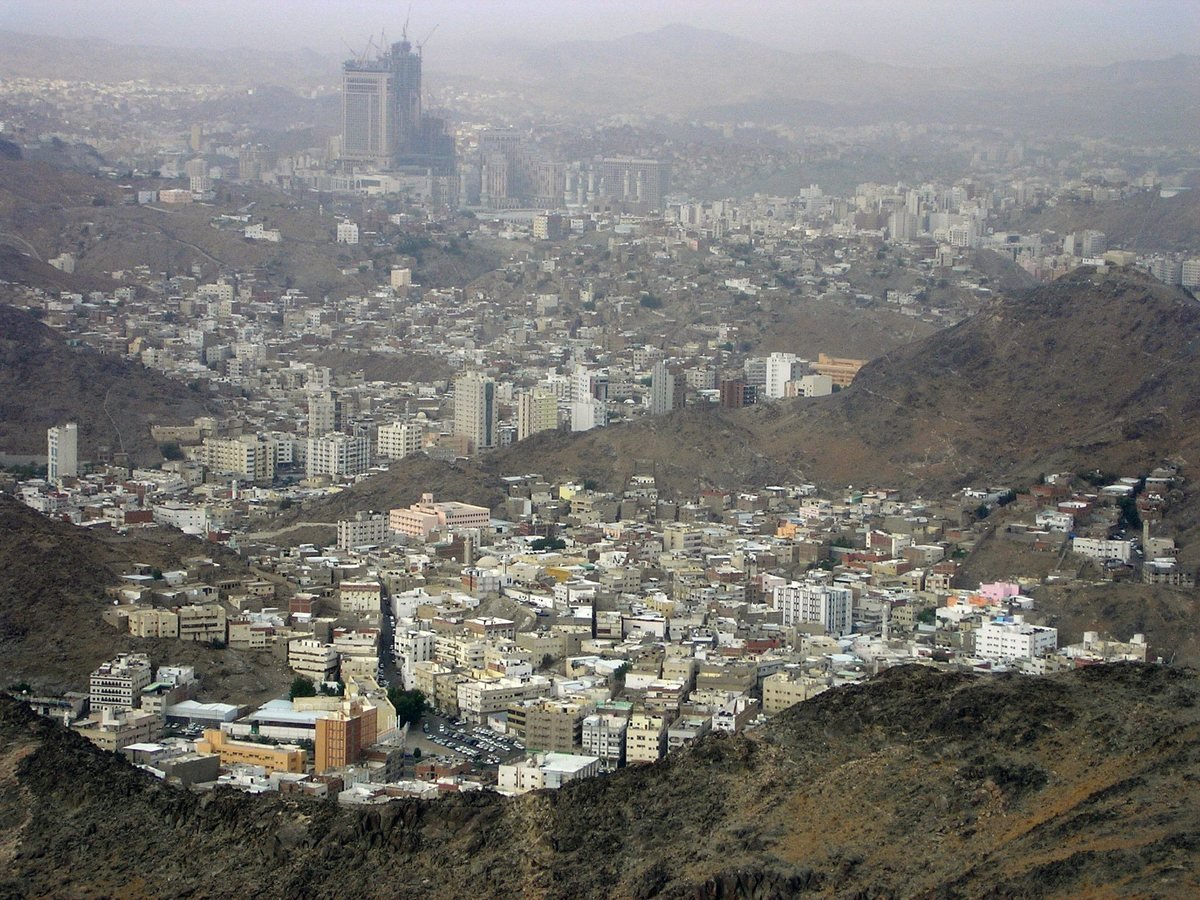
At the Base of the Mountain
The foot of Jabal al Noor has changed in recent years. A cultural district has been developed at the base with exhibitions about the revelation and the Seerah, cafés and visitor facilities, making the stop more comfortable for families and organised groups.
Taxis and ziyarat buses drop passengers here; agree your return arrangement with the driver, or note that taxis circulate at the base through the morning.

Spotting Jabal al Noor from Makkah
You do not have to climb Jabal al Noor to appreciate it.
The mountain’s stacked, double-peaked profile is one of the most recognisable silhouettes in the Makkah skyline: look northeast from the Haram area — past the towers of the Abraj al-Bait — and the steep rocky cone stands apart from the surrounding ridges.
On clear mornings, tiny figures can sometimes be seen moving on its upper path. The rock itself is ancient Precambrian granite-type stone, bare of water and vegetation except for a few thorn bushes — exactly the austere landscape the seerah describes.
Many visitors photograph the mountain at sunrise from the road to Mina before deciding whether to make the climb, and the new facilities at its base have made that viewpoint stop easier than it used to be.
Practical Tips
Climb just after Fajr for shade and space; avoid the midday hours entirely in summer. Wear closed shoes with grip, carry at least a litre of water per person, and keep small children close on the upper steps.
If the full climb is beyond someone in your group, the base area and its exhibitions still make the trip worthwhile, and the mountain can be admired and photographed from below.
Combine the visit with the other sites in our Ziyarat in Makkah guide — Jannat al Mualla is on the way back to the Haram.
Related Guides
- Jabal Thawr: The Mountain of the Hijrah — Cave Thawr Guide
- Mount Arafat and the Plain of Arafat: The Heart of Hajj
- Mina and Muzdalifah: The Tent City and the Night Under the Stars
- Masjid al Jinn: The Mosque Where the Jinn Heard the Quran
- Jabal al Rahmah: The Mount of Mercy at Arafat — Visitor Guide
Frequently Asked Questions
What is Jabal al Noor?
Jabal al Noor, the “Mountain of Light”, is the 642-metre mountain northeast of Makkah that houses Cave Hira, where the Prophet Muhammad ﷺ received the first revelation of the Quran. It is one of the most visited ziyarat places in Makkah.
How high is Jabal al Noor?
The mountain is 642 metres (2,106 ft) tall. Cave Hira sits at a height of about 270 metres, near the summit, reached by roughly 1,750 steps.
How long does it take to climb Jabal al Noor?
Anywhere from 30 minutes to 3 hours. Most pilgrims take 1–2 hours going up at a steady pace with rests. The early morning, just after Fajr, is the coolest and least crowded time to climb.
Can you see the Kaaba from the top of Jabal al Noor?
You can see across Makkah to the Masjid al-Haram complex — its minarets and the Makkah clock tower — on a clear day. Cave Hira itself faces in the direction of the Kaaba, which is one reason the exact spot mattered to the Prophet ﷺ in his retreats.
Is Jabal al Noor the same as Cave Hira?
Not quite — Jabal al Noor is the mountain, and Cave Hira is the small cave near its summit. Pilgrims climb the mountain to reach the cave, so the two names are usually spoken together. Read our dedicated Cave Hira guide for the story of the first revelation.

One thought on “Jabal al Noor: The Mountain of Light — Height, Climb and History”
Comments are closed.